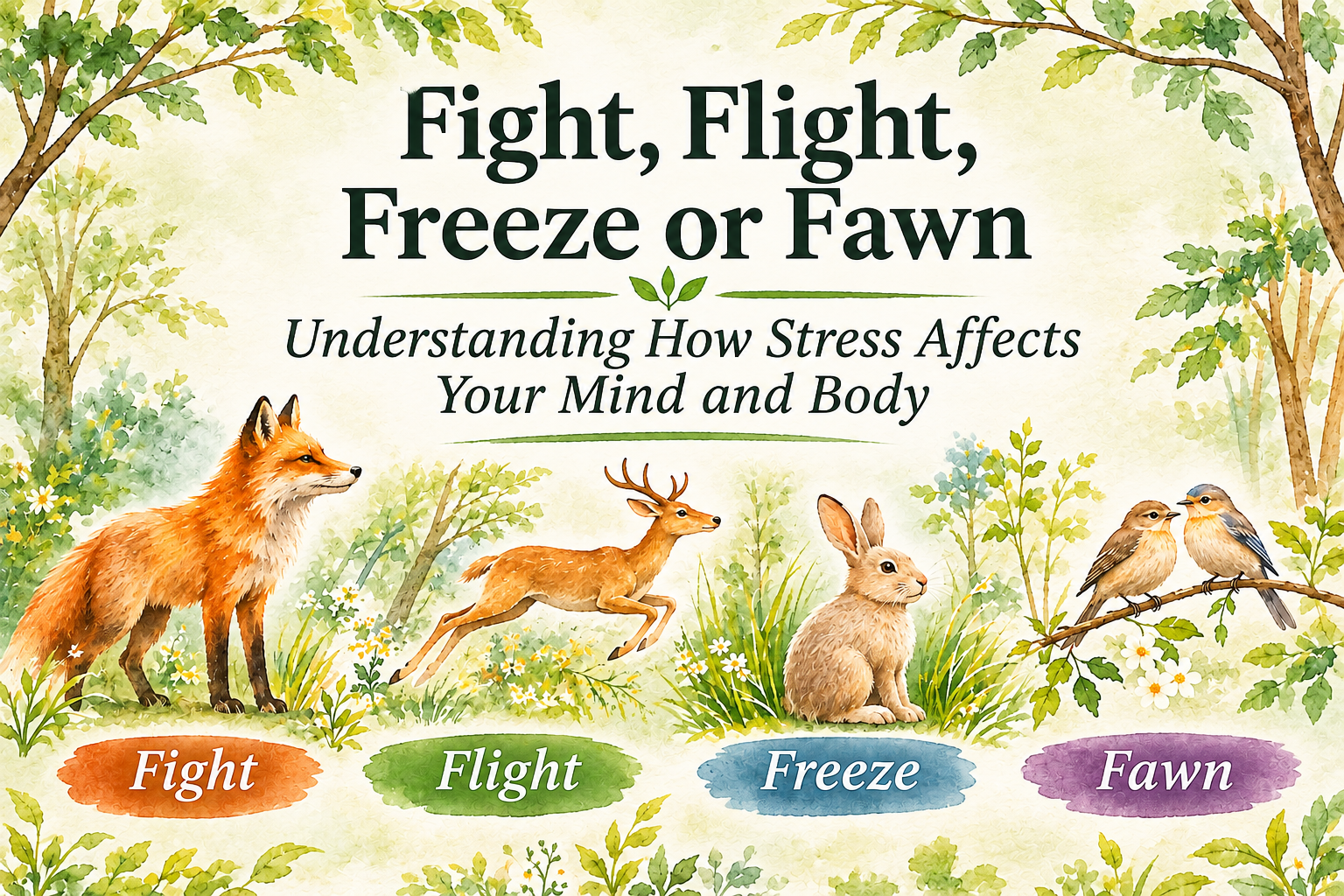
Fight, Flight, Freeze or Fawn: Understanding How Stress Affects Your Mind and Body
Have you ever wondered why some people respond to stress with anger, others feel the need to escape, and some seem unable to respond at all?
Perhaps you’ve experienced moments when your heart races, your muscles tighten, or your mind suddenly goes blank. Or maybe you find yourself agreeing with others simply to avoid conflict, even when it means putting your own needs aside.
These reactions may be connected to the body’s natural stress responses, commonly described as fight, flight, freeze, and fawn.
Understanding these responses can help us recognize the important connection between our nervous system, emotional experiences, and physical well-being.
Your Nervous System: The Body’s Built-In Alarm System
Our nervous system constantly monitors our surroundings, helping us respond to both physical and emotional challenges.
When the brain perceives a potential threat, the body’s stress response can activate automatically. Stress hormones such as adrenaline and cortisol help prepare us to respond.
Our heart rate may increase, breathing may become faster, and muscles may tighten in preparation for action.
This response is essential for survival. However, our bodies don’t always distinguish perfectly between immediate physical danger and the pressures of everyday life.
Work responsibilities, relationship difficulties, financial concerns, past experiences, and ongoing emotional stress can all contribute to activating the body’s stress systems.
When stress becomes frequent or prolonged, returning to a relaxed state may become more difficult.
Understanding the Four Stress Responses
Fight: When the Body Prepares to Defend
The fight response prepares us to confront a perceived threat.
It may appear as irritability, frustration, defensiveness, or a strong desire to regain control.
Physically, we may experience a racing heart, clenched jaw, tight shoulders, or increased muscle tension.
Flight: When the Body Wants to Escape
The flight response prepares us to move away from a perceived threat.
This may look like restlessness, avoiding difficult conversations, excessive busyness, or feeling unable to slow down.
Physically, it can involve rapid breathing, increased heart rate, nervous energy, and difficulty relaxing.
Freeze: When the Body Becomes Still
Sometimes, instead of fighting or escaping, the nervous system responds by inhibiting movement or action.
A person may feel overwhelmed, disconnected, unable to make decisions, or temporarily unable to find the right words.
Freeze can be misunderstood as indecision or a lack of motivation, when it may actually be an automatic response to overwhelming stress.
Fawn: When Keeping Others Happy Feels Safest
Fawn describes a pattern of attempting to maintain safety by pleasing or accommodating others.
This might involve difficulty setting boundaries, apologizing unnecessarily, avoiding disagreement, or placing everyone else’s needs ahead of your own.
Fawning is a useful descriptive concept, although it is not as firmly established as a distinct physiological stress response as fight, flight, and freeze.
Why Does the Body Sometimes Stay in Survival Mode?
Ideally, once a stressful situation has passed, the nervous system gradually returns to its usual state.
However, ongoing stress, difficult life experiences, or repeated exposure to stressful situations can affect how readily our bodies settle.
Some individuals may become more sensitive to situations that remind them of previous experiences. Others may find themselves constantly anticipating problems, even when no immediate danger is present.
This can create a cycle in which emotional stress contributes to physical discomfort, and physical discomfort makes it harder to feel calm.
It is important to understand that these responses are not personal weaknesses. They are influenced by complex interactions between our nervous system, experiences, environment, and overall health.
The Physical Effects of Prolonged Stress
Stress doesn’t exist only in our thoughts. It can influence many systems throughout the body.
Common physical experiences associated with ongoing stress include:
- Muscle tension: Particularly in the neck, shoulders, back, and jaw.
- Changes in breathing: Breathing may become faster or shallower during periods of heightened stress.
- Headaches: Muscle tension and other stress-related changes can contribute to certain headaches.
- Sleep disturbances: An overactive mind or heightened alertness can make restful sleep more difficult.
- Digestive changes: Stress can influence digestion and gastrointestinal comfort.
- Fatigue: Persistent stress may leave someone feeling mentally and physically exhausted.
- Increased sensitivity to discomfort: Stress can influence how the nervous system processes physical sensations.
Not everyone experiences stress in the same way, and these symptoms can have causes unrelated to stress. New, persistent, or worsening symptoms deserve appropriate medical attention.
The Connection Between Muscles and the Nervous System
Our muscles and nervous system work together continuously.
When we perceive danger or experience stress, muscles may automatically prepare for movement or protection.
Over time, repeated tension can contribute to discomfort, restricted movement, or a feeling that certain areas of the body never fully relax.
For example, someone experiencing ongoing stress might unconsciously elevate their shoulders, tighten their jaw, or brace their abdominal muscles.
These patterns are not necessarily intentional. They may develop gradually and become habits that are difficult to recognize.
Understanding the relationship between muscular tension and nervous system activity can help us approach physical discomfort with greater awareness.
Rather than assuming every tight muscle simply needs stronger pressure, it is worth considering the many factors that may be contributing to that tension.
Supporting Your Nervous System Through Everyday Care
There is no single technique that works for everyone. However, several gentle approaches may help support stress management and overall well-being.
Recognize your patterns. Notice how your body responds during challenging situations. Do your shoulders tighten? Does your breathing change? Do you become restless or unusually quiet?
Create opportunities for rest. Even brief periods of quiet or reduced stimulation may help some people feel more settled.
Explore comfortable movement. Walking, gentle stretching, or other enjoyable physical activities can support both physical and emotional health.
Pay attention to breathing. Slow, comfortable breathing exercises may help reduce feelings of stress. Avoid forcing or holding your breath if doing so feels uncomfortable.
Establish supportive boundaries. Recognizing your needs and communicating them can help reduce certain sources of ongoing stress.
Seek support when needed. Counselling and other appropriate healthcare services can help individuals explore emotional patterns and develop coping strategies.
Most importantly, remember that managing stress is not about forcing yourself to relax. It is about discovering what helps you feel supported and better able to respond to life’s challenges.
How Touchstone Approaches Whole-Person Wellness
At Touchstone, we recognize that physical comfort and emotional well-being are closely connected.
Our approach considers the individual rather than focusing solely on an isolated area of discomfort.
Through services such as Manual Lymphatic Drainage (MLD), Deep Muscle Therapy (DMT), Cranial-Sacral Therapy, Reflexology, and Counselling with a Registered Psychotherapist (Qualifying), Touchstone offers different avenues of support depending on individual needs.
Hands-on therapies may provide opportunities for relaxation and physical comfort, while counselling can offer a supportive environment for exploring emotional experiences, stress, and coping strategies.
These services have different purposes and evidence bases. They should not be understood as interchangeable treatments for trauma or nervous system disorders.
Our goal is to encourage greater awareness, informed choices, and a thoughtful approach to individual wellness.
Understanding Your Response Is a Step Toward Greater Awareness
Fight, flight, freeze, and fawn remind us that stress can influence our thoughts, emotions, behaviours, and physical experiences.
We may respond differently depending on the situation, our personal history, and the resources available to us.
Learning to recognize these patterns can help us approach ourselves and others with greater patience and understanding.
Your body and mind are connected. Learning to listen to both can be an important part of caring for your overall well-being.
At Touchstone, we believe that understanding the body is an important part of supporting the whole person.
Discover more about our Therapeutic Services or contact Touchstone to learn how we may be able to support your wellness journey.